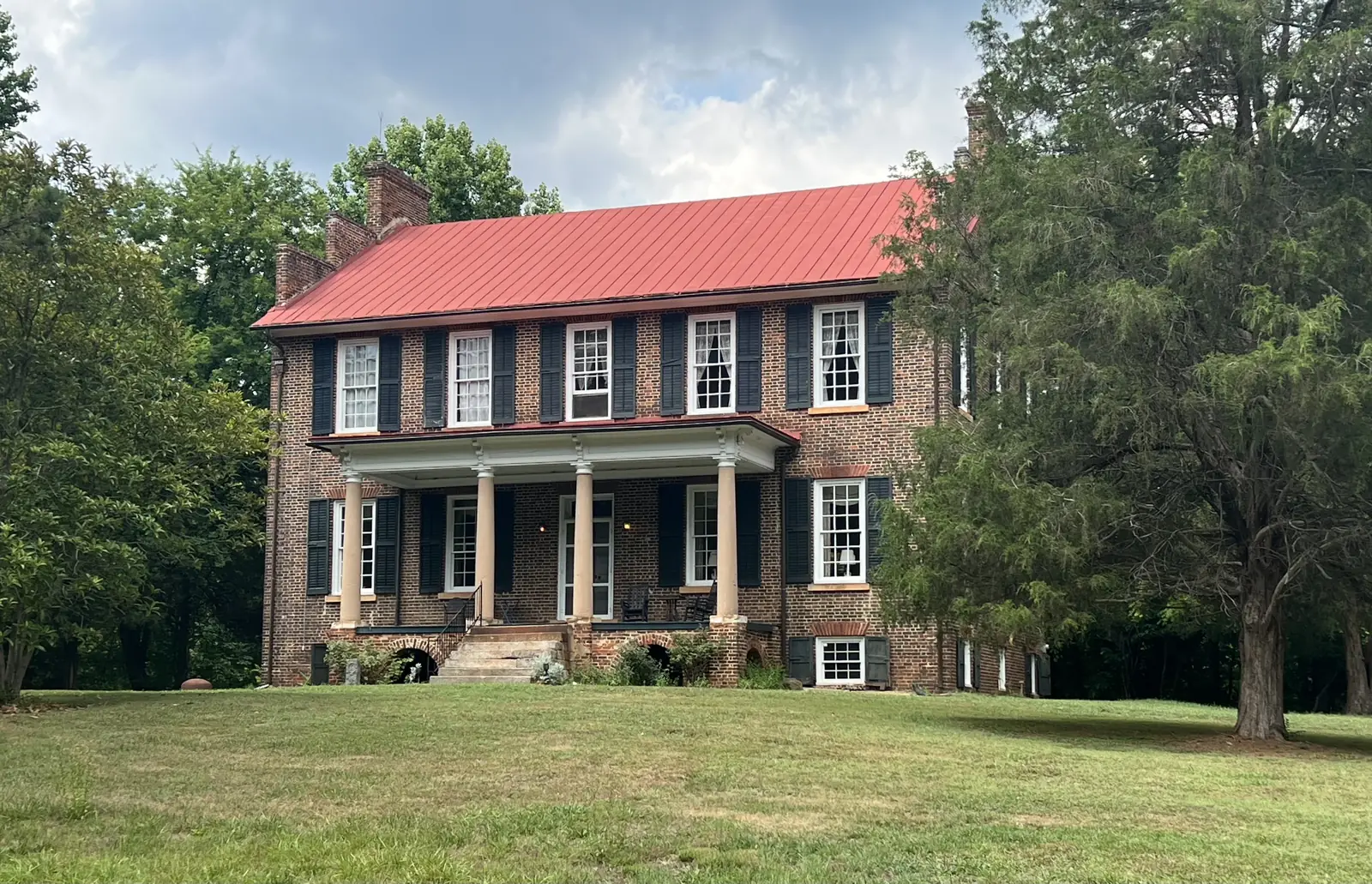
Huntersville became a town in 1873. Ten of its properties are on the National Register, from Holly Bend and Latta House to Ingleside, added in 2020.
Last checked Oct. 11, 2026. Facts come from the Town of Huntersville’s historical and cultural landmarks page and notable events page, the National Park Service’s National Register of Historic Places data, the county’s local historic landmark list from the Charlotte-Mecklenburg Historic Landmarks Commission and the N.C. Department of Natural and Cultural Resources’ highway marker program.
Huntersville was incorporated in 1873; the town celebrated 150 years as a municipality in 2023, according to its anniversary page. The land around it was settled long before that: the town says Hopewell Presbyterian Church was established in 1762, and more than 30 historic and cultural landmarks, from churches and homesteads to schools, date to the 1700s and 1800s. Town history questions: Huntersville Communications, 704-464-5522.
A short timeline
From the town’s landmark and notable-events pages:
- 1762: Hopewell Presbyterian Church is established, with roots in the late 1740s or early 1750s.
- 1772: Samuel Blythe acquires the land of what is now the Blythe Homestead.
- Feb. 1, 1781: Gen. William Lee Davidson is killed at Cowan’s Ford on the Catawba River as Cornwallis crosses after a sharp fight, two state historical markers record.
- 1795 to 1800: Robert Davidson builds Holly Bend on 420 acres his father, John Davidson, gave him.
- 1831: Cedar Grove, one of the finest Greek Revival houses left in the county and the Piedmont, is built.
- 1873: Huntersville is incorporated.
- 1879: Huntersville High School is founded by the Rev. William H. Orr and Lula May Hunter Orr.
- 1916: the town switches on its first electric lighting system.
- 1927: the Board of Commissioners approves a town water and sewer system.
- 1935: the first stoplight goes up, most likely at today’s Gilead and Old Statesville roads, and the town jail, now its oldest surviving municipal building, is built about then.
- 1973: Lonnie Hager becomes Huntersville’s first town manager.
National Register of Historic Places
Properties in Huntersville or with a Huntersville location on the National Park Service’s register, with the month they were listed:
| Property | Listed | Location (as listed) |
|---|---|---|
| Cedar Grove | February 1972 | West of Huntersville |
| Holly Bend | March 1972 | West of Huntersville |
| Latta House (Latta Place) | March 1972 | South of Huntersville |
| Benjamin W. Davidson House (Oak Lawn) | April 1976 | West of Huntersville |
| St. Mark’s Episcopal Church | March 1984; boundary enlarged February 1991 | Mount Holly-Huntersville Road |
| Samuel J. McElroy House | February 1991 | 10915 Beatties Ford Road |
| Ramah Presbyterian Church and Cemetery | February 1991 | State Road 2439 |
| Thomas and Latitia Gluyas House | July 2001 | 7314 Mount Holly-Huntersville Road |
| Huntersville Colored High School (Torrence-Lytle School) | August 2009 | 302 Holbrooks Road |
| Ingleside | December 2020 | Bud Henderson Road |
The town says the Torrence-Lytle School was the first chance for Black residents of north Mecklenburg to attend a public high school close to home.
Historic downtown
Downtown Huntersville sits along Main Street near Gilead Road. The county landmarks list designates the former Bank of Huntersville, 100 Main St. (about 1900), part of a commercial row at 100 to 106 Main St., and Walters Barbershop, 112 S. Main St. (about 1920). Nearby are the Ranson House, 412 S. Old Statesville Road (1913), built by descendants of two families the town credits with creating Huntersville, and the Blythe House, 121 Gilead Road (about 1910). The 1938 agricultural education building stands at Huntersville Elementary, 200 Gilead Road, and Huntersville School No. 2, 508 Dellwood Drive (1912), is one of six surviving Rosenwald schools in the county, the town says.
Places you can visit
- Historic Rural Hill, 4431 Neck Road: the 1788 plantation landmark, now a county nature preserve with trails, events and the Bethesda Schoolhouse (about 1898), a memorial to Mecklenburg’s Black schools. The main house burned in 1886; outbuildings, two schoolhouses and a family cemetery remain, the town says. Call 704-875-3113 for hours.
- Latta Place, 5225 Sample Road: the 52-acre plantation of merchant James Latta, built about 1800. The county’s park data lists the historic site as closed; check with Mecklenburg County Park and Recreation, 980-314-1001.
- Hugh Torance House and Store, 8231 Gilead Road (about 1780): the town calls it North Carolina’s oldest surviving store.
- Torrance Mill: the town says it is the most imposing antebellum mill ruin left in the county.
Some landmarks are private property. Unless a site says it is open, view it from the road.
Markers and monuments
- Battle of Cowan’s Ford (L-22), N.C. 73 at the Catawba River west of Huntersville: “Cornwallis, pursuing Greene, crossed the Catawba, 7 mi. w., after sharp fight, Feb. 1, 1781.” Cast in 1939.
- William Lee Davidson (L-23), Beatties Ford Road: the Whig general “was killed at Cowan’s Ford, Feb. 1, 1781.”
- General William Lee Davidson Monument, 5455 Cashion Road, and the Cowans Ford Davidson College Monument, 14910 N.C. 73: both about 1920 and designated county landmarks in 2022.
What this means for you
- Start at Rural Hill for history you can walk through, and downtown Main Street for the town’s commercial past.
- Some landmark houses are private property; unless a site is open, stay on the road.
- The town’s landmark map plots every site for a driving tour.
More: parks and trails and Huntersville population and growth.
Frequently asked questions
When was Huntersville founded?
Huntersville was incorporated as a town in 1873. The town marked 150 years as a municipality with a yearlong celebration in 2023.
What is the oldest building in Huntersville?
The Hugh Torance House and Store, dated to about 1780 by the county landmarks commission, is called North Carolina’s oldest surviving store by the town and is one of the county’s few 18th-century buildings.
What National Register sites are in Huntersville?
Ten properties: Holly Bend, Cedar Grove and Latta House (all 1972), the Benjamin W. Davidson House (1976), St. Mark’s Episcopal Church (1984), the McElroy House and Ramah Presbyterian Church (1991), the Gluyas House (2001), Huntersville Colored High School (2009) and Ingleside (2020).
Can I visit Rural Hill in Huntersville?
Yes. Historic Rural Hill, 4431 Neck Road, is a county nature preserve and historic farm site with trails and events. Call 704-875-3113 for current hours.
Have your say